Guided Market Tour Empowering Vitamin A Sweet Potato Farmers in Zimbabwe
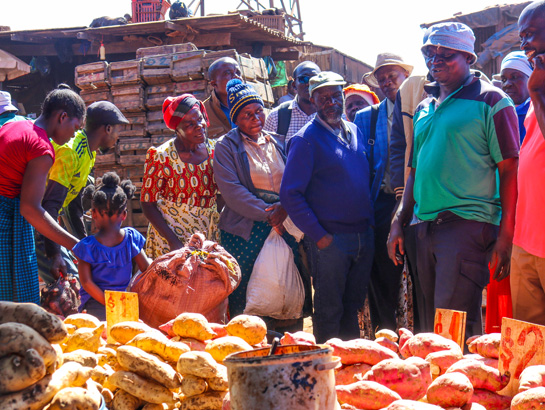
As part of efforts to enhance market literacy among smallholder farmers, the Scaling Nutrition Resilience in Zimbabwe project, implemented by HarvestPlus, recently organized an educational tour of the Mbare Musika Fresh Produce Market in Harare, a bustling trading hub. The tour brought together over ten smallholder farmers from Guruve, Mt. Darwin, Mazowe, and Bindura, who grow vitamin A-rich orange sweet potatoes. Notably, some participating farmers were making a timely pre-harvest experience. The aim was to equip them with real-time insights into market dynamics, addressing critical challenges such as unfair produce grading, low pricing, and restricted market access.
“Most of us used to rely solely on what the sweet potato buyers told us when they visited our farms,” shared Mrs. Sarudzai Mupfurutsa, a smallholder farmer from Guruve. “But seeing the market for myself opened my eyes. I now understand the difference between Grade A and Grade C sweet potatoes–Grade A are clean, large, and unbruised, and they sell faster and for a better price.”
Elisha Maringe, another participant from Guruve, echoed this sentiment: “I saw traders selling sweet potatoes that looked like mine at double the price I had initially expected. Now I understand what’s fair, and I’ll be able to negotiate with more confidence.”
During the visit, the farmers observed how sweet potatoes are sorted, graded, priced, and sold — often by the bucket, sack, or heap, depending on the season. They also interacted directly with traders, gaining valuable knowledge and initiating relationships that could support future market engagements.
“Marketing is just as important to farming as agronomy,” noted Sakile Kudita, HarvestPlus Zimbabwe Country Manager. “By exposing farmers to the realities of how produce is traded — particularly at the country’s largest fresh produce market — we empower them to make more informed decisions about pricing, grading, and marketing their crops. This ultimately helps them earn more while promoting the consumption of nutrient-dense foods.”
The tour reinforced the importance of market knowledge. Farmers learned that timing their harvests strategically, presenting their produce attractively, and understanding quality standards are critical for securing better prices and building a stronger market presence.
“I used to think my vitamin A orange sweet potatoes had little value in the market,” said Mrs. Mupfurutsa. “Now I see they’re special—they’re nutritious, and people want them. I just need to present them well and speak the language of nutrition.”