Beyond Survival: How Biofortified Crops Built a Home, a Business, and a Legacy
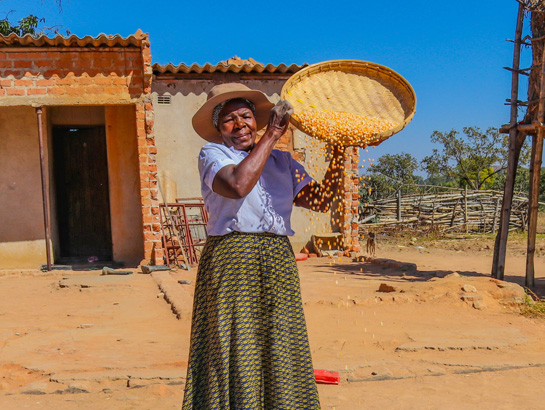
In 2024, hunger remained a pressing challenge, affecting 673 million people worldwide, 307 million of whom were in Africa alone. Rising food prices have made healthy diets unaffordable for many rural families. Yet, in Ward 17, Bindura, Zimbabwe, a farmer is showing how biofortified crops can help fight hunger, improve health, and transform livelihoods.
Mrs. Joice Jacobs, affectionately known in her community as “Mama veOrange Maize” was among the first to adopt biofortified crops under the UK Aid-funded Livelihoods and Food Security Programme (LFSP). When the program ended in 2019, many wondered whether farmers would continue growing biofortified crops or abandon them. But five years later, Joice’s story was the answer. She not only continued farming biofortified crops but built her identity and success around them, becoming an inspiration for other farmers in her community.
Once struggling to survive on vegetable sales, “selling vegetables was a gamble,” she recalls. Joice turned her fortunes around by embracing vitamin A maize, iron beans, and vitamin A orange sweet potatoes. In 2023–24 planting season, Joice sold two tons of vitamin A maize and used the profits to install a borehole. That investment was a turning point in her farming enterprise as she could now grow her crops all year round. “I can proudly say my tiled house was built by vitamin A maize,” she says with pride.
Joice’s journey reached new heights in 2024 when the “Expanding Nutrients in Food Systems” project, implemented by HarvestPlus with support from the Government of Canada, introduced her to vitamin A orange sweet potato vine multiplication. Recognized for her commitment, Joice was selected to establish a vitamin A orange sweet potato vine nursery — an opportunity she seized wholeheartedly. She invested in a greenhouse, designed to trap sunlight and regulate temperature and humidity, creating a controlled environment for plant growth. With reliable water from her borehole, she built a thriving hub supplying virus-free planting material to her neighbors. Within one year, the vitamin A orange sweet potato vine nursery flourished and generated enough profit for her to purchase a cow – further strengthening and diversifying her household assets.
Joice’s success story captures the strengths of biofortification. For farmers, these crops deliver good yields and resilience. For households, they provide essential micronutrients that fight hidden hunger. For rural families, they generate income that lifts livelihoods and improves quality of life. Globally, biofortification is recognized as a cost-effective strategy against malnutrition, delivering up to seventeen dollars in benefits for every dollar invested – making it more sustainable approach than any other strategy.
Today, “Mama veOrange Maize” is more than a farmer. She is a role model and advocate, proving that biofortification is not just about growing food, but about farming nutrition, building prosperity, and showing that with the right tools, rural communities can thrive long after projects end.